

 ASIC Design Services
 IPs and Capabilities
 FPGA to ASIC
 Data Logger
 Electrochemical Sensor
 Image Sensor
 Tolling IC
 Semiconductor Manufacturing
 Test Services
.png) Foundry Tape-Out Services
Foundry Tape-Out Services
 Aerospace
 Medical
 Mobility
A practical guide to evaluating cost, performance, power consumption, and flexibility when moving from FPGA prototypes to production-ready ASICs.
FPGAs have become an essential tool for semiconductor development, enabling rapid prototyping, design flexibility, and faster time-to-market. Their programmability makes them particularly well suited for proof-of-concept designs and early-stage product development.
However, what makes an FPGA ideal during development can become a limitation once a product reaches production. As manufacturing volumes increase and performance requirements evolve, many product teams eventually face the same question: is it time to move to an ASIC?
FPGA-to-ASIC conversion is a common step in the semiconductor lifecycle, allowing OEMs to optimize cost, power consumption, performance, and supply chain resilience. The transition is not always driven by production volumes alone and often depends on a combination of technical, commercial, and product lifecycle considerations.
This article explores when FPGA-to-ASIC conversion makes sense, what benefits it can provide, and how to approach the transition successfully.
When Does an FPGA Become a Limitation?
FPGAs offer unmatched flexibility during development, but they are inherently designed as general-purpose programmable devices. As products mature, this flexibility can come at the expense of several key parameters.
Common limitations of FPGA-based production systems include:
-
Higher unit cost compared with application-specific silicon.
-
Increased power consumption.
-
Larger PCB footprint and more external components.
-
Performance limitations for specific applications.
-
Supply chain and long-term availability challenges.
-
Difficulties meeting stringent size or reliability requirements.
-
Product lifecycle constraints in industrial and medical applications.
For products entering volume production or requiring long-term availability, these limitations can significantly impact the overall competitiveness of the final device.
FPGA vs ASIC: Key Differences
|
FPGA |
ASIC |
|
Highly programmable |
Application-specific architecture |
|
Low development cost |
Higher initial development investment |
|
Ideal for prototyping |
Optimized for production |
|
Higher power consumption |
Lower power consumption |
|
Larger silicon area |
Higher integration |
|
Higher unit cost |
Lower cost at volume |
|
Rapid design iterations |
Optimized performance and reliability |
|
Flexible functionality |
Customizable to application requirements |
The choice is therefore not a question of whether one technology is better than the other, but rather which technology is best suited to a product's current stage of development and production objectives.
What Are the Benefits of FPGA-to-ASIC Conversion?
Moving from FPGA to ASIC can unlock significant advantages across the entire product lifecycle.
Lower System Cost
Although ASIC development requires a higher upfront investment, the resulting reduction in unit cost often delivers substantial savings in production. In many cases, ASIC integration also enables a reduction in the overall bill of materials (BOM) by replacing multiple external components with a single chip solution.
Improved Power Consumption
Power consumption is one of the primary reasons companies migrate from FPGA to ASIC. Custom silicon can be optimized specifically for the target application, making ASICs particularly attractive for battery-powered and ultra-low-power systems.
Enhanced Performance and Integration
ASICs can be designed to meet stringent performance requirements while integrating analog, digital, RF, sensor interfaces, security features, or communication blocks within a single device. This level of integration enables:
-
Smaller form factors
-
Improved system reliability
-
Higher performance
-
Simplified PCB design
Greater Control Over Product Lifecycle
Many industrial, medical, and communication products are designed to remain in the field for 10 years or more. Developing a custom ASIC provides greater control over technology selection, manufacturing processes, and supply chain strategy, helping manufacturers mitigate component obsolescence risks.
Improved Reliability and Manufacturability
Unlike programmable logic devices designed for broad market applications, ASICs are optimized for a specific product's requirements. This optimization can simplify manufacturing, qualification, and certification activities in regulated markets.
Is FPGA-to-ASIC Conversion Right for Every Project?
A common misconception is that ASIC development is only justified for very high production volumes.
In reality, production volume is only one of several decision criteria.
Questions that product teams should consider include:
-
What is the expected product lifetime?
-
Are power consumption or form factor becoming limiting factors?
-
Is the FPGA significantly contributing to system cost?
-
Does the application require enhanced security or reliability?
-
Are there supply chain or obsolescence concerns?
-
Is the product architecture mature enough for production?
-
Will the product family evolve?
Many industrial, medical, and communication applications justify ASIC development at relatively modest production volumes when power, integration, or lifecycle requirements are taken into account.
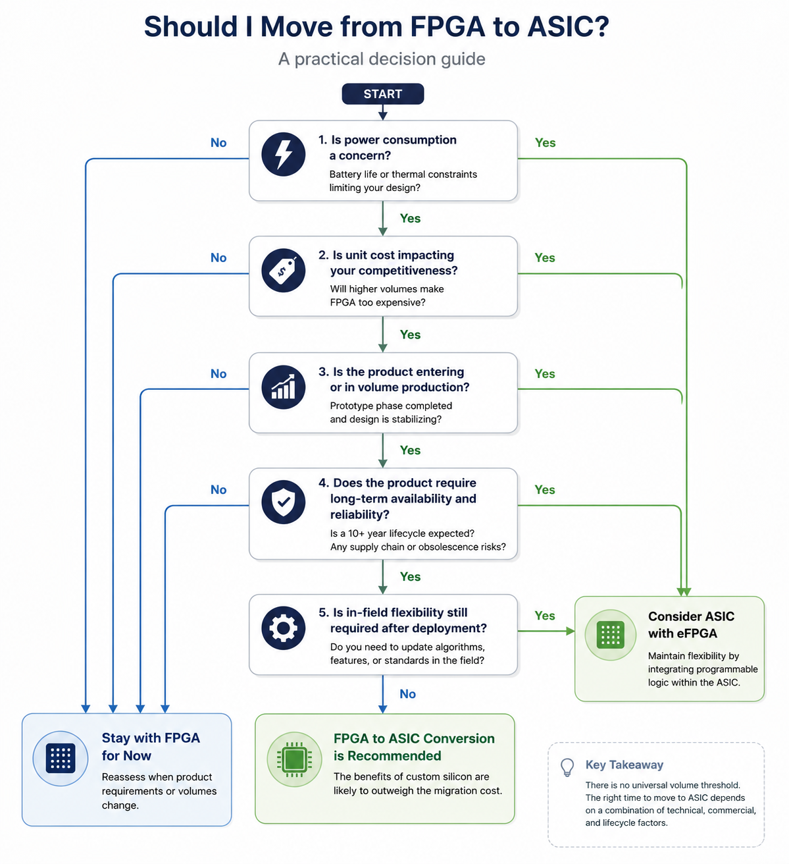
The decision to migrate from FPGA to ASIC should therefore be considered as part of an overall product strategy rather than a purely financial calculation.
What Does the FPGA-to-ASIC Conversion Process Look Like?
Successfully transitioning from FPGA to ASIC involves much more than simply porting an existing design.
Typical FPGA-to-ASIC conversion projects include:
-
Feasibility and cost analysis.
-
Architecture definition and specification review.
-
RTL and IP evaluation.
-
Technology and process node selection.
-
ASIC design and verification.
-
Tape-out and foundry management.
-
Silicon validation and qualification.
-
Test development and industrialization.
-
Volume production and supply chain management.
Early feasibility studies are particularly important as they help determine which parts of the design should remain configurable and which functions can be optimized in silicon.
Products originally developed on FPGA often benefit from significant architectural improvements during the conversion process, resulting in higher performance and lower manufacturing costs.
What About Flexibility?
One of the main concerns when moving from FPGA to ASIC is the perceived loss of flexibility.
Unlike FPGAs, traditional ASICs cannot be reprogrammed once manufactured. This limitation has historically led some product teams to delay ASIC migration to retain field programmability.
However, semiconductor technologies continue to evolve.
Embedded FPGA (eFPGA) IP enables designers to integrate programmable logic directly within an ASIC, creating a hybrid approach that combines the benefits of custom silicon with post-silicon flexibility.
Depending on the application, eFPGA technology can enable:
-
Hardware updates after manufacturing
-
Algorithm modifications and optimizations
-
Security and cryptographic updates
-
Product differentiation across multiple variants
-
Greater adaptability to evolving standards and market requirements
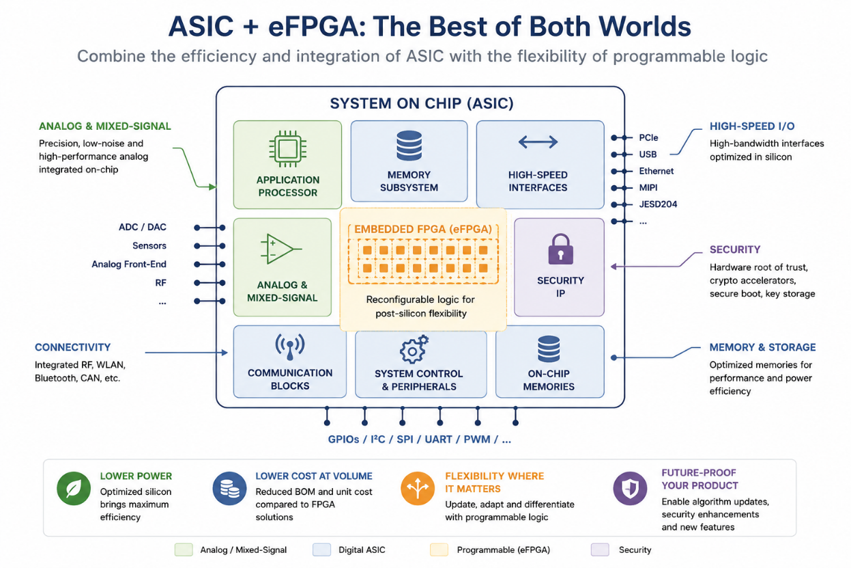
For certain applications, FPGA-to-ASIC conversion no longer means sacrificing flexibility—it simply means optimizing where programmability is required.
Embedded FPGA technology is opening new possibilities for agile ASIC development, particularly in markets where products must remain secure, configurable, and adaptable throughout their lifecycle.
In a future article, we will explore how eFPGA is transforming FPGA-to-ASIC conversion strategies and enabling more flexible semiconductor products.
Choosing the Right Time to Move to ASIC
FPGA-to-ASIC conversion is much more than a cost optimization exercise. It is a strategic decision that can significantly improve product performance, power consumption, reliability, and long-term manufacturability.
By evaluating the technical and commercial requirements of a product early in its lifecycle, development teams can make more informed decisions about when—and how—to transition from programmable logic to custom silicon.
Whether driven by cost reduction, ultra-low-power requirements, product longevity, or increased integration, FPGA-to-ASIC conversion remains one of the most effective ways to optimize semiconductor products for production.
.png)